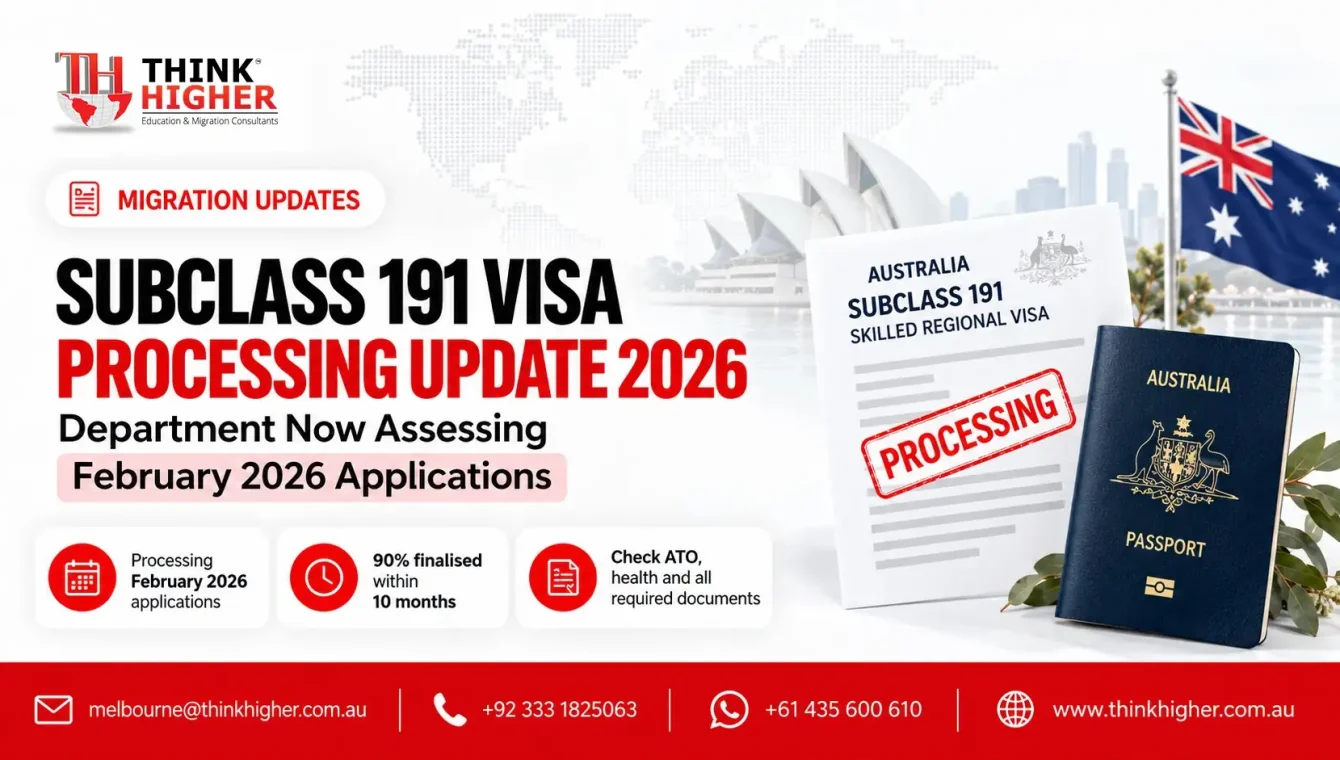
The Department of Home Affairs has issued a new processing update for the Permanent Residence (Skilled Regional) visa subclass 191.
According to the Department’s latest communication, it is now processing subclass 191 applications lodged from February 2026, and 90% of applications are being finalised within 10 months. Applicants whose files are approaching assessment have also been asked to check that all required documents are already attached so avoidable gaps do not slow the decision.
Subclass 191 Processing Update Overview
| Update | Current position |
|---|---|
| Visa | Permanent Residence Skilled Regional subclass 191 |
| Applications currently being processed | From February 2026 |
| Processing timeframe | 90% finalised within 10 months |
| Processing priority | Ministerial Direction 122 |
| Important documents highlighted | ATO Notices of Assessment |
| Health check issue to watch | New age milestones reached before visa decision |
| Additional documents | Upload through ImmiAccount |
The 10-month figure is a processing guide, not a guaranteed decision date for every application. Home Affairs says actual processing can vary depending on whether the application is complete, how quickly further information is provided, external health and character checks, and migration program availability.
Why Subclass 191 Applications Have a Different Processing Priority
Skilled visa applications are now processed under Ministerial Direction 122, which came into effect on 19 September 2026 and replaced the relevant priorities previously operating under Direction 119. Subclass 191 is one of the permanent and provisional skilled visas covered by the new direction.
Direction 122 gives first priority to applications connected with areas such as:
- Construction
- Healthcare
- Teaching
- Agriculture
- Aquaculture
- Fishing
- Resources
- Australia's law enforcement and defence interests
The difference for subclass 191 is that the visa application is not made against a particular nominated occupation. Because of this, a subclass 191 application does not receive the same occupation-based priority that some other skilled applications can receive.
This helps explain why applicants may see other skilled visa subclasses moving at different speeds even where those applications were lodged later.
Check Your ATO Notices of Assessment Before Your File Is Reviewed
The Department has specifically reminded subclass 191 applicants to check their income evidence.
For the Regional Provisional stream, you need to provide Australian Taxation Office Notices of Assessment for three income years out of the five years of your eligible visa.
No Minimum Income Requirement
This point can easily cause confusion. The subclass 191 Regional Provisional stream does not currently have a minimum income threshold. You still need to provide the required ATO Notices of Assessment, but the requirement is about supplying the evidence, not proving that your income exceeded a particular minimum amount.
So before your application reaches a case officer, check that you have uploaded the correct ATO documents for the required three income years.
Do You Owe Money to the ATO?
If you or an applicable family member owe money to the Australian Taxation Office, this should also be dealt with.
You should have either:
- paid the debt, or
- entered into an approved payment arrangement.
Evidence of the payment or approved arrangement should be attached to the application. The Department has warned that missing evidence in this area may delay processing.
Health Examinations May Need to Be Updated
Health requirements must be satisfied when the Department makes its decision.
This can become important when an applicant or family member completed their Immigration Medical Examinations earlier in the process and then reached a new age milestone before the visa was granted.
The Department has highlighted the following ages:
- 2 years
- 11 years
- 15 years
If an applicant reaches one of these ages after completing the original medical examinations but before the subclass 191 decision, additional health examinations may be required.
You do not need to guess which new examination is required. The processing officer will advise you if you or a family member needs further health checks after reviewing the individual circumstances of the application.
Who Is the Subclass 191 Regional Provisional Stream For?
The Regional Provisional stream provides a permanent residence pathway for eligible holders of:
- Skilled Work Regional Provisional visa subclass 491, or
- Skilled Employer Sponsored Regional Provisional visa subclass 494.
The primary applicant must hold an eligible visa when applying and must generally have held it for at least three years. Applicants must also have complied with the conditions attached to their eligible visa.
The visa is permanent and, once granted, allows the holder to live, work and study in Australia permanently.
What Else Should Be Ready Before Assessment?
The Department's email focuses particularly on ATO evidence and health examinations, but a decision can also be delayed if other required information is missing.
Before your application moves further, it is worth checking that your file contains the documents relevant to your circumstances, including:
- Identity documents
- Required ATO Notices of Assessment
- Evidence of any ATO payment arrangement, where applicable
- Character documents
- Family and relationship evidence, where applicable
- Documents requested by the Department after lodgement
- Updated information if your personal circumstances have changed
Home Affairs notes that it can make a decision without asking an applicant to provide missing documents, so it is better not to rely on receiving a request before completing the file.
Has Your Child Reached a New Age While the Visa Is Processing?
Families should pay particular attention to changes that occur during a long processing period.
For example, if a child was 10 years old when the original medical examination was completed but has now turned 11, the child has reached one of the health examination milestones identified by the Department.
Similarly, applicants should review whether:
- a dependant has reached a new age category
- passport details have changed
- family circumstances have changed
- a child has been born since lodgement
- contact details have changed
Changes should be updated through the appropriate Home Affairs process rather than waiting until a decision is close.
Need to Add Documents? Use ImmiAccount
If additional documents are required, applicants should upload them through ImmiAccount.
This includes information that was not attached at lodgement or new documents that become relevant while the application is being processed.
Home Affairs also advises that it does not provide individual progress updates for applications under assessment. Applicants should use ImmiAccount to check whether further information has been requested.
What Should Subclass 191 Applicants Do Now?
If your application was lodged around the period the Department is currently processing, this is a good time to review the file rather than waiting for a case officer to contact you.
A practical check would be:
- Review your ATO Notices of AssessmentMake sure three income years from the relevant five-year period are covered.
- Check any ATO debtUpload evidence that it has been paid or that an approved payment plan is in place.
- Review health examination datesConsider whether anyone included in the application has since turned 2, 11 or 15.
- Check your supporting documentsMake sure required identity, character and family evidence is available and current.
- Review ImmiAccountCheck for messages or requests and upload additional information there.
- Update any changed circumstancesDo not leave changes in passports, addresses, relationships or family composition until the last minute.
What the February 2026 Processing Update Means
Applicants should not read the Department's statement that it is processing February 2026 applications as a promise that every application lodged in that month will immediately receive a decision.
Applications do not necessarily move in a simple first-in, first-out order. Ministerial Direction 122, completeness of the application, health and character checks and individual circumstances can all affect how quickly a particular case progresses.
The useful message from this update is simpler: subclass 191 processing has moved into applications lodged from February 2026, and applicants approaching assessment should make sure their files are complete now.
How Think Higher Can Help
If you have already lodged a subclass 191 application, Think Higher Consultants can review the documents currently attached to your application and identify information that may need updating before the Department assesses the case.
This can include checking your ATO Notices of Assessment, eligible visa history, supporting documents, family information and any requests received through ImmiAccount.
For applicants preparing to lodge, reviewing these requirements before submission can also reduce the risk of avoidable document gaps during processing.
The Department's latest update is a useful reminder that once a subclass 191 application reaches assessment, having the right evidence already in place can make the process much smoother.