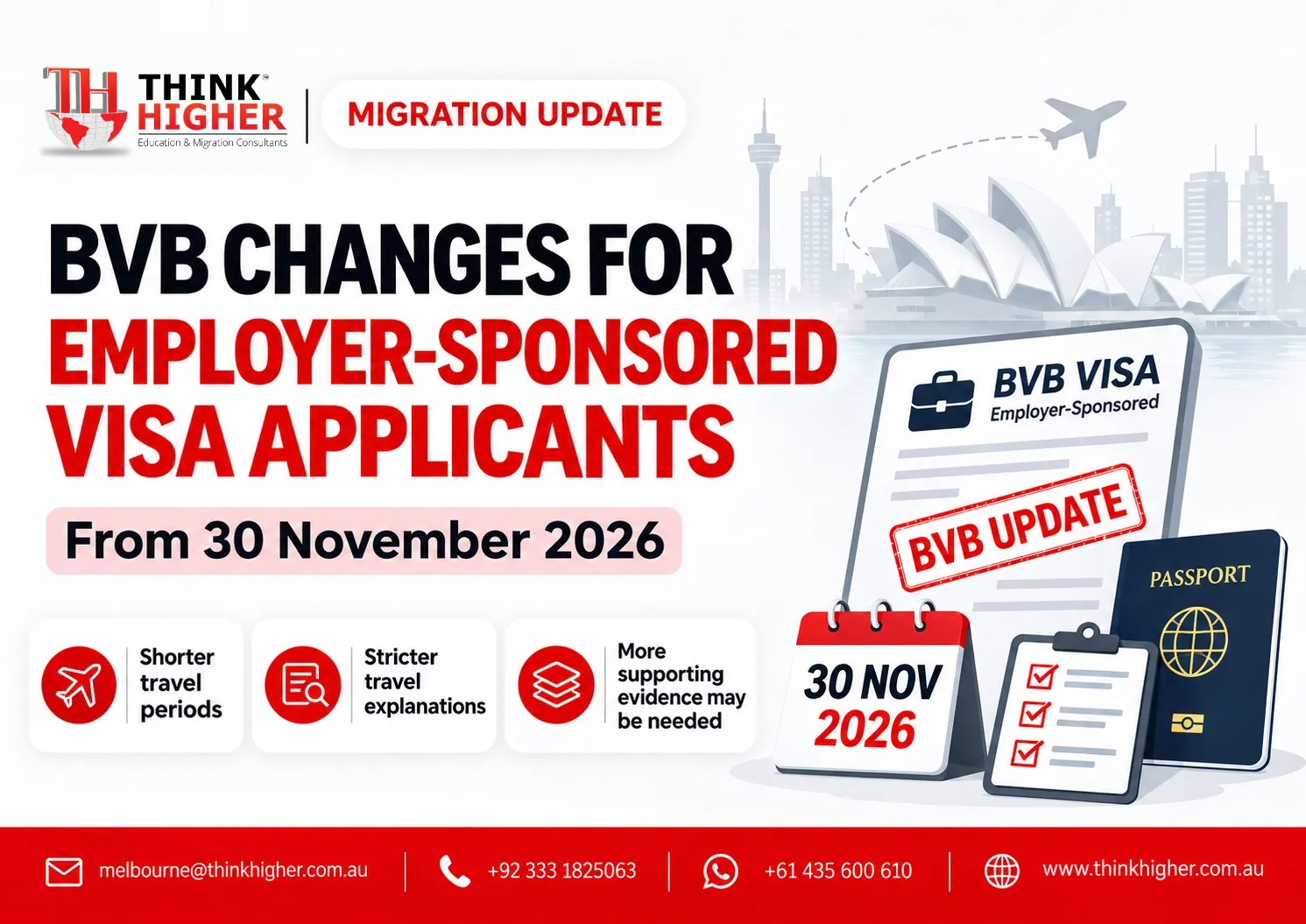
From 30 November 2026, the Department of Home Affairs will change how newly lodged Bridging Visa B (BVB) applications linked to employer-sponsored visa matters are assessed.
The main change is the travel facility period. New BVBs will generally be granted for shorter periods that more closely reflect the applicant’s reason for travel, proposed travel dates and individual circumstances. Applicants will also need to explain their travel purpose clearly and provide relevant supporting information where required.
The existing BVB eligibility rules have not changed. Applicants must still demonstrate substantial reasons for leaving and returning to Australia. BVB applications lodged before 30 November 2026 will continue to be processed under recent practice unless the Department specifically asks for further information.
What Changes from 30 November?
For new BVB applications associated with employer-sponsored visa matters, the Department says travel facilities will generally no longer be granted for lengthy periods as a matter of course.
Instead, the travel period is expected to reflect:
- why the applicant needs to travel
- when the applicant intends to leave Australia
- how long the trip is expected to last
- the applicant’s individual circumstances
This means the explanation provided in the BVB application will carry more practical importance.
A vague statement that someone simply wants to travel may not give the decision-maker enough information to determine the appropriate travel period.
How the BVB Travel Period Will Be Decided
A BVB allows an eligible bridging visa holder to leave Australia and return during a defined travel period while a substantive visa application or certain review proceedings remain unresolved.
Home Affairs already states that a BVB travel period is determined by considering:
- the reason for travel
- when the Department is likely to decide the substantive visa application.
For example, if an applicant demonstrates a specific trip of two weeks for an important family matter, they should not assume the Department will automatically grant a travel facility covering several months.
The BVB grant notice will specify the approved travel period, and that period cannot simply be extended after grant.
The Reason for Travel Must Be Clearly Explained
A central BVB requirement is that the applicant has substantial reasons for wishing to leave and re-enter Australia while the substantive visa matter remains unresolved.
Home Affairs already requires applicants to provide a reason for travel and attach relevant supporting documents.
From 30 November, applicants associated with employer-sponsored visa applications should expect greater attention to the detail provided about the trip.
A strong explanation should make clear:
- the purpose of travel
- the expected departure date
- the expected return date
- the expected duration
- why the trip is necessary or important
- any circumstances supporting the request
The purpose is not to write a long statement. It is to give the Department enough information to understand why travel is required and what travel period is reasonably needed.
Holiday and Family Travel Needs More Detail
A holiday or family visit is not automatically excluded as a reason for requesting a BVB. However, simply describing the trip in broad terms may not provide enough information to demonstrate substantial reasons for travel.
Applicants should explain why the trip is taking place, the intended travel dates, how long they expect to remain overseas and any circumstances that make the travel important. Where relevant, supporting documents should be provided.
For urgent circumstances, such as visiting a seriously ill family member, medical or hospital evidence may help the Department assess the reason for travel.
What Evidence Should Be Provided?
The type of supporting material should match the reason for travel.
Depending on the circumstances, evidence may include:
- medical or hospital documents relating to a family member
- wedding or event information
- evidence of a significant family circumstance
- business or professional meeting details
- conference registration
- documents explaining another specific travel commitment
- information showing the planned travel period
Applicants should avoid attaching large amounts of unrelated material.
The supporting documents should help answer one question:
Why does this applicant have a substantial reason to leave and return to Australia during this period?
Home Affairs confirms that supporting documents should be attached to explain why the applicant needs to depart and return while their substantive visa is still being considered.
You Do Not Need to Buy Flights Before Applying
The Department has specifically advised that applicants do not need to purchase flights simply to demonstrate an intention to travel.
This is important because a BVB must be granted before the applicant leaves Australia if they need the BVB to return.
Home Affairs warns that applicants who leave without the necessary travel permission may not be able to return on their existing bridging visa.
Applicants should therefore be cautious about booking expensive or non-refundable travel before the BVB has been decided.
What Happens to BVB Applications Lodged Before 30 November?
The Department has advised that applications lodged before 30 November 2026 will continue to be processed in line with recent practice.
Applicants and representatives do not need to send additional material for those existing applications unless Home Affairs specifically requests it.
This transitional point is important.
The new assessment approach is directed at newly lodged applications from 30 November, rather than requiring every pending BVB applicant to resubmit their case.
Applicants with genuine overseas travel planned who are already within Home Affairs’ recommended application window may wish to review their BVB position before the new approach begins. Lodging earlier does not guarantee a longer travel facility.
Who Can Apply for a Bridging Visa B?
The broader BVB eligibility criteria remain in place.
Home Affairs states that an applicant generally needs to:
- be in Australia when applying
- hold a Bridging Visa A or B
- have an eligible substantive visa application that has not been finally determined, or qualifying judicial review proceedings
- have substantial reasons for needing to leave and return to Australia.
A BVB does not provide unlimited travel rights.
If granted, it allows departure and return only within the travel period specified in the visa grant.
Why Is the Department Changing Its Approach?
The Department’s communication links the change to how processing resources are being managed while Ministerial Directions 121 and 122 are implemented.
Both Directions commenced on 19 September 2026 and established processing priorities for specified skilled visa applications.
Direction 121 covers temporary skilled visas including subclass 482, while Direction 122 covers specified provisional and permanent skilled visas including subclasses 186 and 494, among others.
The Department says the BVB adjustment is intended to better align decision-making with the existing BVB rules while allowing more processing effort to be directed toward substantive visa and nomination decisions.
Importantly, Directions 121 and 122 do not change the BVB eligibility criteria. They provide the processing context for why the Department is changing its operational approach.
Preparing a BVB Application After 30 November
Before lodging, make sure the travel purpose, proposed dates and requested travel period are clearly explained and supported where relevant. Applicants should also lodge within the recommended two-week to three-month window.
The application should make it easy for the delegate to understand both why the applicant needs to travel and how much travel time is reasonably required.