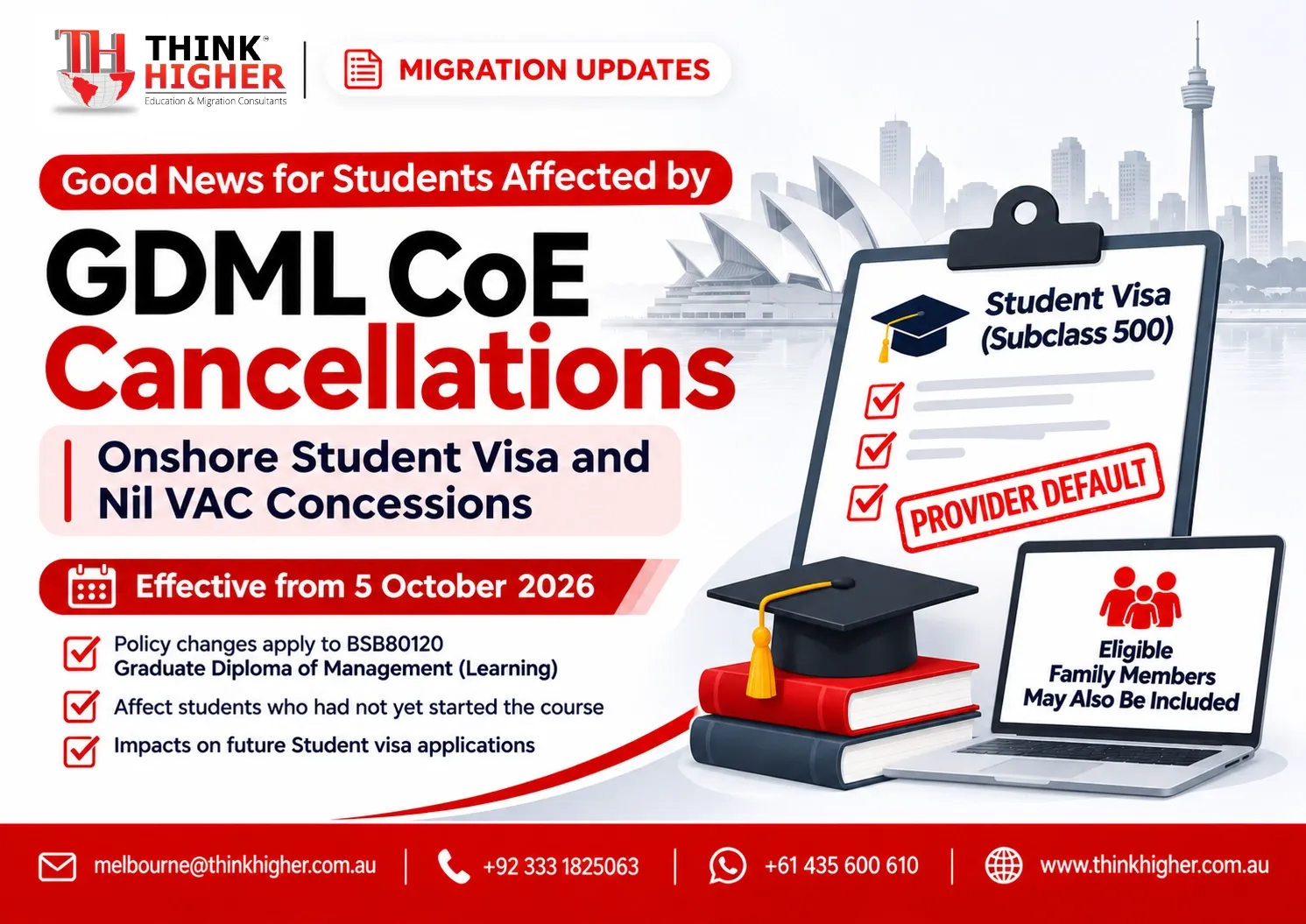
There is an important positive update for students and families affected by the Graduate Diploma of Management (Learning) (BSB80120) CoE auto-cancellations on 5 October 2026.
Affected students whose circumstances meet the provider-default requirements may be able to lodge a further Subclass 500 Student visa from inside Australia and qualify for a nil Visa Application Charge (VAC). Certain eligible family members already connected to the student’s existing Subclass 500 visa may also be included in the same application and access the relevant concession.
This provides an important pathway for students who need additional time in Australia to continue their studies through an alternative registered course. However, eligibility depends on the student’s individual provider-default circumstances, visa history, new study arrangements and the applicable 12-month application period.
What Happened to Graduate Diploma of Management (Learning) CoEs?
From 5 October 2026, the rules changed for students who had not yet started the BSB80120 Graduate Diploma of Management (Learning).
Students who had not commenced the qualification could no longer begin the course, and affected GDML CoEs were automatically cancelled.
Students who had already commenced the qualification before the change can generally continue studying and complete it.
The visa issue therefore mainly affects students who had planned to study the GDML but could no longer proceed because their enrolment was affected by the cancellation.
GDML CoE Cancellation Can Fall Under Provider Default
The important development for affected students is that the GDML cancellation can fall within Australia’s provider-default framework where the relevant requirements are satisfied.
Provider default can arise where a registered course:
-
Does not start on the agreed commencement date.
-
Stops before the student completes it.
-
Cannot be provided in full.
For affected GDML students, this classification matters because provider default can activate specific Student visa concessions.
It does not mean every person connected with a GDML course automatically qualifies. The student’s individual enrolment and visa circumstances still need to fall within the relevant rules.
Eligible Students Can Lodge Their Next Student Visa Onshore
One of the most important benefits is the ability for a qualifying affected student to lodge a further Subclass 500 Student visa while remaining in Australia.
This matters because the current Student visa framework restricts many Student visa holders from lodging another Student visa onshore unless an exemption applies.
Provider default is one of those exemptions. For an eligible GDML student, this may mean they do not need to leave Australia simply to make the next Student visa application.
The student must still meet the relevant provider-default requirements and the normal requirements applying to the new Student visa.
Eligible Applicants Can Qualify for a $0 Visa Application Charge
The second major benefit is the nil Visa Application Charge. An eligible student affected by provider default can qualify to lodge the further Student visa without paying the usual Student visa application charge where the prescribed conditions are met.
Relevant factors include whether the student:
-
Was enrolled in the affected course on the provider-default day.
-
Holds a Student visa, or their most recent substantive visa was a Student visa.
-
Needs another Subclass 500 visa to continue their studies in an alternative registered course.
-
Applies within the required provider-default period.
-
Has not previously relied on the same provider default for another Student visa application.
This is why the concession is better described as a nil VAC for eligible provider-default applicants, rather than a free visa extension available to every affected student.
Can Family Members Be Included?
There is also positive news for some affected families. Qualifying family members who are already connected to the primary student’s existing Subclass 500 visa may be able to be included in the further Student visa application.
The family-member concession is not a general opportunity to add any new dependents. The relevant family member generally needs to already hold a Subclass 500 visa as a secondary applicant linked to the same primary Student visa holder.
Where the requirements are met and the applications are combined, eligible family members may also qualify for the nil VAC concession.
Where family members are included under the provider-default arrangements, the primary applicant and accompanying family members must also meet the applicable location requirements when the combined application is lodged.
This distinction is important because the provider-default provisions do not reopen the general Student visa subsequent-entrant pathway for new family members.
The Application Must Be Made Within the Provider-Default Period
Affected students should pay close attention to the time limit.
The further Student visa application generally needs to be lodged within 12 months of the relevant provider-default day.
The relevant day can depend on what happened in the individual case.
For example:
-
Where the course never started, the relevant date may relate to the agreed course commencement date.
-
Where a course stopped after commencement, it can relate to the date the course ceased to be provided.
For affected GDML auto-cancellation cases, departmental guidance indicates that 5 October 2026 may be relevant where another specific provider-default date cannot be identified.
Students should therefore confirm their own provider-default date rather than assuming the same deadline applies to everyone.
A New Course and CoE Will Still Be Required
The provider-default exemption does not remove the need for genuine further study.
A student who needs another Student visa will generally need an appropriate alternative CRICOS-registered course and a new Confirmation of Enrolment.
Before lodging, the student should consider:
-
Which course they intend to study.
-
How well the course aligns with their previous studies and future plans.
-
The status of their Confirmation of Enrolment (CoE) and whether it has been validly issued.
-
The course duration and if a further Student visa will be required.
-
How the proposed study plan fits the relevant Student visa requirements.
There is no single government list of replacement courses that automatically applies to every affected GDML student.
The appropriate course depends on the student’s circumstances.
What Happens With Tuition Fees and Alternative Study?
Provider default also creates obligations for the education provider. Where provider default applies, the education provider generally has 14 days after the default to either arrange a suitable alternative course accepted by the student or refund the relevant unspent tuition fees.
Where the provider cannot meet those obligations, the Tuition Protection Service (TPS) may assist affected international students with alternative study options or eligible tuition refunds.
This is separate from the Student visa concession but can be important when planning the student’s next course and CoE.
What Affected GDML Students Should Check Now
Students affected by the GDML CoE cancellations should confirm:
-
Confirmation that their CoE was affected by the cancellation.
-
Their eligibility under the provider-default requirements.
-
The relevant provider-default date for their case.
-
Their position within the 12-month application period.
-
Eligibility to lodge a further Student visa from inside Australia.
-
Eligibility for the nil Visa Application Charge (VAC).
-
The alternative registered course they intend to study.
-
Confirmation that a new CoE has been issued.
-
The eligibility and location requirements for any accompanying family members.
These points should be checked before relying on the provider-default exemptions.
Key Takeaways for Affected GDML Students
Students affected by the GDML CoE cancellations may have access to important provider-default Student visa concessions, including onshore lodgement and a nil VAC where the requirements are met.
Qualifying existing family members may also benefit, but separate eligibility and application requirements apply.
The student’s provider-default circumstances, relevant deadline, new CoE and future study arrangements should all be checked before lodging.