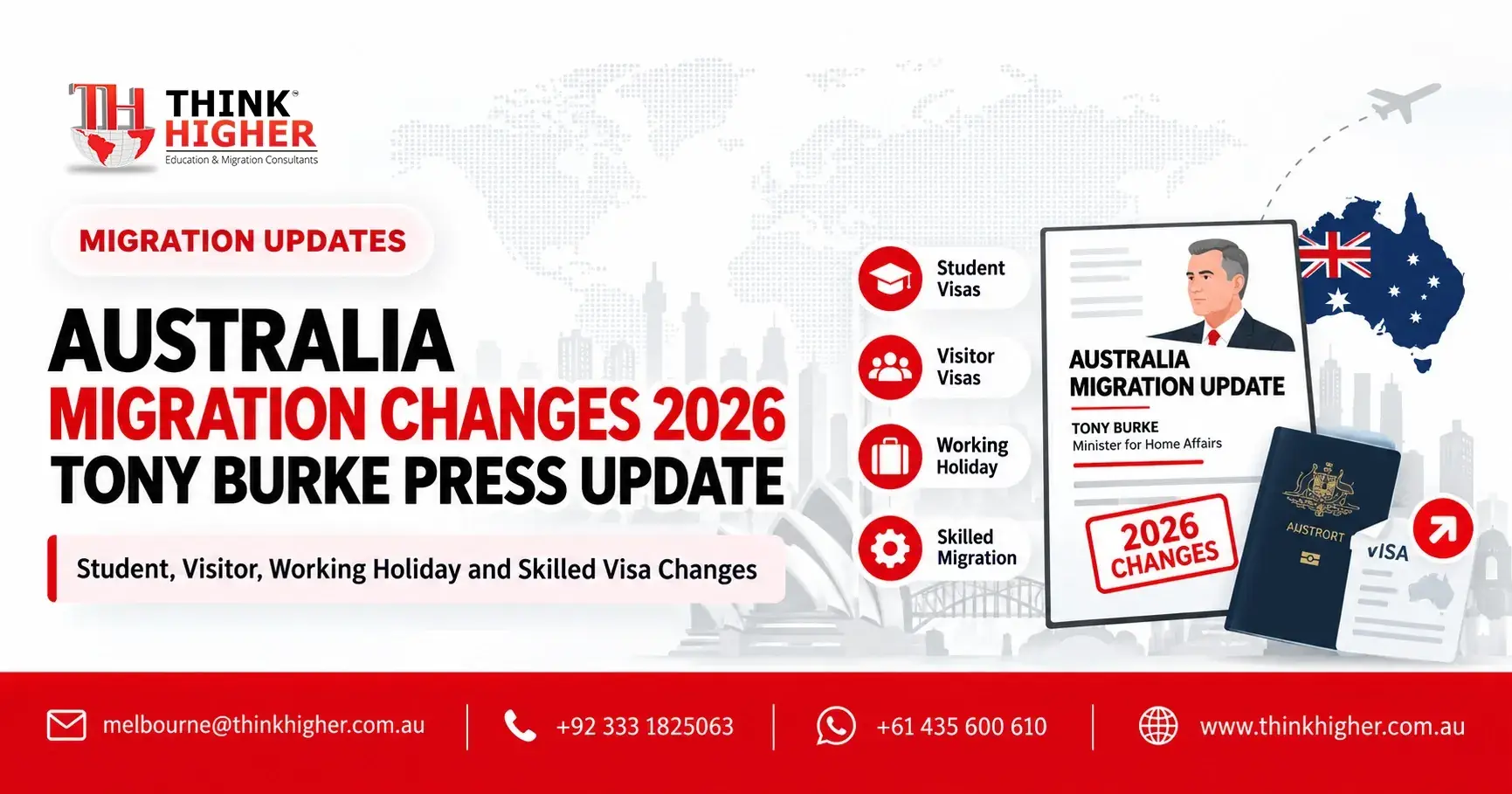
Home Affairs Minister Tony Burke delivered a National Press Club address in Canberra on 17 September 2026, followed by questions from journalists. So, it was not technically a stand-alone press conference, but the minister did publicly announce the government's new migration measures and then take media questions.
The package focuses mainly on temporary migration, including international students and their families, visitor visas, Working Holiday Makers, skilled migration priorities and people who remain in Australia after their visas expire. The government says the aim is to reduce net overseas migration while continuing to bring in workers needed in areas such as construction, health, agriculture and education.
The Main Announcements
Here is the update in one view:
| Area | Announced change |
|---|---|
| International students | Most future students will face tighter rules on bringing family members |
| Student course changes | Students will be expected to progress to a higher qualification level rather than move sideways or down |
| Visitor visas | No Further Stay conditions are planned for future visitor visas |
| Working Holiday visas | Ballots will be introduced for second and third-year visas |
| Skilled migration | Priority settings will be expanded towards construction, agriculture, fisheries and teaching |
| Construction trades | Relevant trade qualifications are planned to receive stronger points treatment |
| Visa overstayers | 100 more compliance officers and extra detention capacity are planned |
| Migration agents | Stronger compliance action is planned against agents involved in fraudulent or non-genuine applications |
| Character test | Further changes are planned in relation to family violence and hate-related conduct |
International Students and Family Members
One of the most important announcements for the international education sector relates to secondary applicants, such as partners and children.
Under the announced policy, most future international students will no longer have the same ability to bring family members to Australia through their student visa arrangements. He said there would be exceptions, including special settings for people from Pacific and ASEAN countries and students undertaking certain programs such as PhDs.
What about families already in Australia?
The minister was clear that the government does not intend to separate families who are already here under existing visa arrangements. The change is aimed at future visas, rather than removing dependents already attached to an existing visa in Australia.
That distinction is important. Current students should not assume that the announcement automatically changes an existing family member's visa status. The final commencement date and detailed transitional rules still need to be published.
Students Will Need to Show Genuine Course Progression
The government is also targeting repeated course changes that appear to be used mainly to extend a person's stay in Australia. He gave a simple example of what the government considers normal progression:
That is moving up the qualification scale and is not the type of movement being targeted.
The concern is where a student completes one qualification and then moves repeatedly into courses at the same or a lower level, particularly through providers where the main purpose may appear to be maintaining visa status rather than genuine education.
The announced direction is therefore:
- genuine progression to a higher qualification can continue
- moving down the qualification scale will face tighter restrictions
- same-level course changes may also receive more scrutiny
The exact rules, exceptions and start date have not yet been released.
Visitor Visas Will Face Tighter Onshore Rules
Another significant announcement concerns people who arrive on a visitor visa and later try to move into a longer-term visa pathway from inside Australia.
Burke announced that a No Further Stay condition will be attached to future visitor visas. In practical terms, this is intended to make it harder to use a visitor visa as an entry route before switching to another visa onshore.
Does this Affect People Already in Australia?
He said the new approach is intended for future visas and will not retrospectively change the conditions of people who are already in Australia under existing visas.
The exact operation of No Further Stay conditions, including any waiver arrangements or exemptions, will need to be checked once Home Affairs releases the formal rules.
Working Holiday Visas Will Move to Ballots for Years Two and Three
The Working Holiday Maker Program is also set for a substantial change. At present, eligible applicants can access a second or third Working Holiday visa after completing the required specified work.
Under the announced system, completing that work will make an applicant eligible for a ballot, rather than automatically giving them access to the next visa year.
Second-year Working Holiday visa
Applicants would still need to complete the relevant regional or specified work, commonly around 88 days.
A ballot will then apply, with 45,000 second-year places proposed. He said about 57,000 people qualified for a second year in the current cohort.
Third-year Working Holiday visa
For the third year, applicants would still need the required work history, including approximately six months of specified work during the second year.
The proposed third-year ballot will be much smaller, with 5,000 places, compared with around 31,000 people in that group this year.
UK passport holders
The government said the changes will not override Australia's existing Free Trade Agreement arrangements with the United Kingdom. Eligible UK Working Holiday Makers currently receive different treatment under that agreement.
Skilled Migration Priorities Are Being Adjusted Again
The government is also changing the way skilled visa applications are prioritised.
He said Ministerial Direction 119 will be updated so that additional priority is given to occupations Australia needs in areas including:
- Construction
- Agriculture
- Fisheries
- Teaching
The purpose is to target migration more closely towards workforce shortages rather than applying the same processing approach across all occupations.
This is also expected to allow Working Holiday Maker processing to return closer to normal speeds after recent slowing of the program.
Construction Trade Qualifications and Points
There was also an important announcement for people in construction trades. He said relevant construction trade qualifications will receive the same education-points treatment as a university degree under the proposed changes.
The reason given was to make it easier to attract workers needed for Australia's housing and construction workforce.
However, applicants should not calculate new points yet based only on the announcement.
The government still needs to publish:
- Which trade qualifications qualify
- Exactly how many points will apply
- The commencement date
- Whether transitional rules apply
Until the formal points settings are released, the current points test should continue to be used.
Stronger Enforcement for Visa Overstayers
The government also announced a stronger compliance response for people who remain in Australia after their visa has expired.
Burke referred to approximately 77,000 visa overstayers and announced:
- 100 additional compliance officers
- 250 additional detention beds
- Consideration of using Melbourne's former quarantine facility for immigration detention
- Increased activity aimed at locating and removing people who no longer have a valid visa
He said the approach would move Australia closer to the compliance system used before 2015 rather than copying the type of immigration enforcement seen in the United States.
Migration Agents and Fraudulent Applications
The government also intends to increase scrutiny of migration agents involved in fraudulent, non-genuine or abusive visa applications.
Reporting from the announcement indicates that stronger penalties and compliance measures are planned.
Detailed penalty amounts and enforcement arrangements have not yet been published, so applicants and agents should wait for the formal rules rather than relying on speculation.
Character Test Changes
Further changes are also planned for Australia's visa character framework. The government indicated that future settings will give greater attention to serious conduct involving:
- Family violence
- Hatred or hate-related behaviour
Again, the detailed ministerial direction has not yet been published, so the precise legal test will need to be reviewed once it becomes available.
What Was Discussed but Not Announced
Before the National Press Club address, there had been reports about possible changes to protection visa applications, including tighter timeframes and changes to work rights for people whose protection claims had already been refused.
During the media questions, he was asked about those proposals but declined to provide further detail. He said the government wanted to prioritise genuine protection claims while dealing with people who knowingly lodge claims without a valid basis. So, those possible changes should not yet be presented as part of the confirmed package.
Why Is the Government Making These Changes?
The migration announcement came on the same day the Australian Bureau of Statistics reported that annual Net Overseas Migration had fallen to around 292,000.
The government wants that figure to continue falling, with Budget assumptions pointing towards approximately:
- 245,000 in 2026–27
- 225,000 in 2027–28
Burke argued that migration settings need to respond to housing and infrastructure pressure, while still bringing in workers needed by the economy.
The approach therefore focuses more heavily on temporary visas, extended stays and visa compliance, rather than simply reducing every migration category by the same amount.
Announced Today vs Already in Force
At the time of writing, further detail is still needed on:
- When student dependant restrictions begin
- Which student categories receive exemptions
- Treatment of applications already lodged
- Exact student course-progression rules
- How No Further Stay will be applied to visitor visas
- Second and third-year Working Holiday ballot dates and procedures
- The updated Ministerial Direction 119
- New construction trade points
- Updated migration-agent penalties
- The revised character-test direction
Applicants should therefore check whether a change is already legally in force before making decisions based on today's announcement.
What Should Applicants Do Now?
There is no need to panic or immediately change an application simply because the minister has announced new policy settings.
A practical approach is:
- Check the rules currently applying to your visa.
- Do not assume an announced rule has already commenced.
- If you have a student, visitor or Working Holiday application in progress, check whether transitional arrangements are later announced.
- Skilled migrants should wait for the revised priority direction and points details before changing their strategy.
- Use the latest Home Affairs information when lodging rather than relying on social media headlines.
How Think Higher Can Help
The announcements could affect international students, visitor visa holders, Working Holiday Makers, skilled migrants, construction tradespeople and applicants planning future onshore visa pathways.
Think Higher Consultants can help review how the changes relate to an individual case once the government publishes the formal regulations, visa conditions and commencement dates.
For anyone preparing an application now, the safest approach is to work from the migration rules currently in force, while keeping track of the announced changes that may apply to future applications.