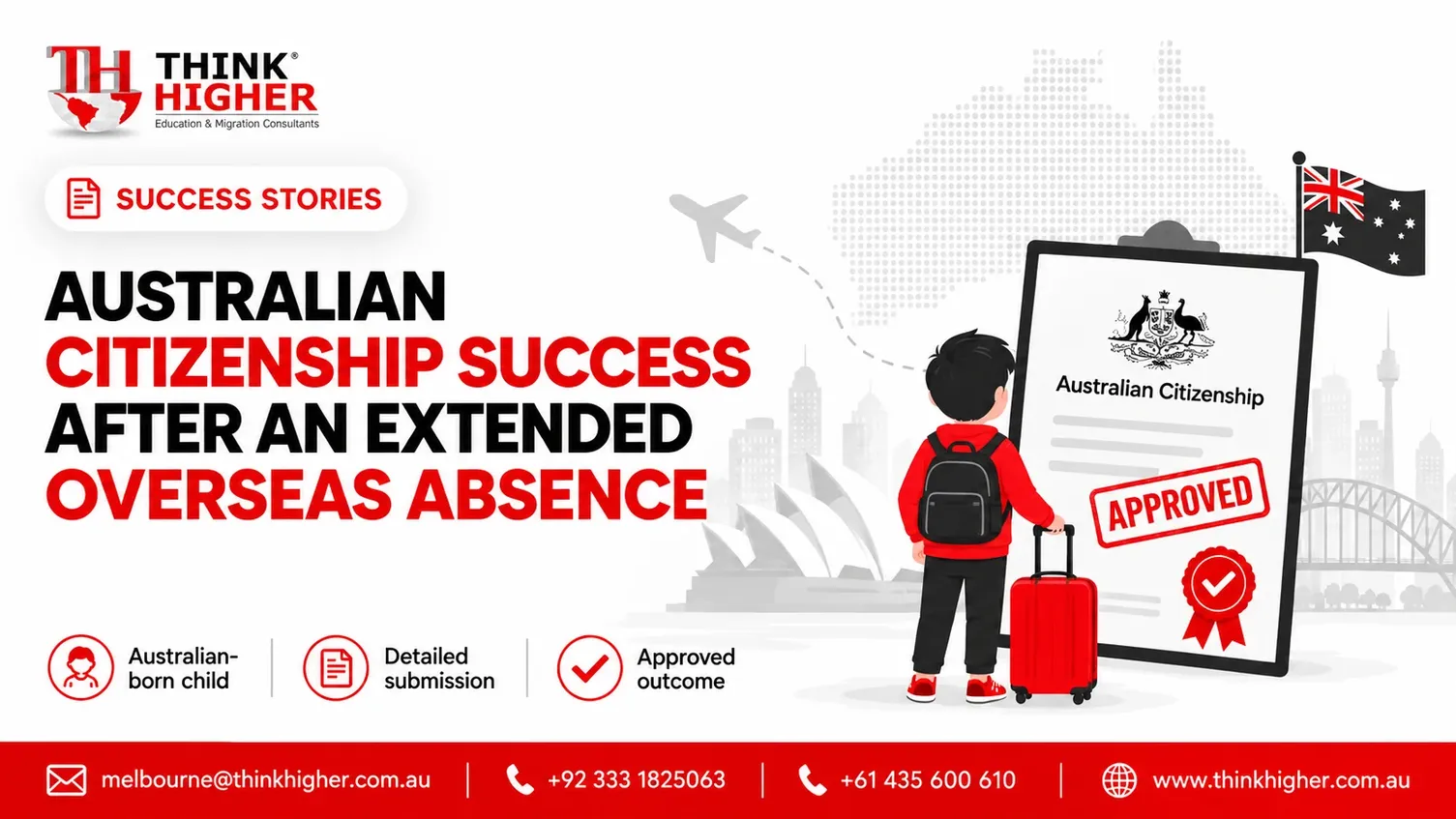
A family approached Think Higher with an Australian citizenship matter involving their Australian-born daughter. Although she was born in Australia, she had spent approximately 4 years and 8 months in India during the first 10 years of her life, which meant her residence history needed to be carefully addressed.
What was originally intended to be a short stay overseas became much longer because of family circumstances, COVID-19 and other delays. Think Higher reviewed the family's history, prepared a detailed submission and provided supporting evidence explaining the absence. The application for Evidence of Australian citizenship was approved on 10 September 2026.
How the Family’s Situation Developed
The child's parents came to Australia in 2016 on student visas, and their daughter was born in Australia while they were living here.
A few years later, the family needed to send their daughter to India because of family circumstances. The intention was for her to stay there for a short period and then return to Australia. However, those plans did not happen as expected.
A Short Trip Became a Long Absence
COVID-19 created major disruption to international travel and family arrangements. Together with other circumstances affecting the family, the child's return to Australia was delayed considerably.
What had started as a temporary stay eventually became an overseas absence of around 4 years and 8 months.
When the family later needed to establish their daughter's Australian citizenship status, this lengthy period outside Australia became an important part of the application.
Why the First 10 Years Matter for Australian Citizenship
Being born in Australia does not automatically make every child an Australian citizen.
Citizenship at Birth
Under Australian citizenship law, a child born in Australia is generally an Australian citizen at birth if at least one parent was an Australian citizen or permanent resident when the child was born.
In this family's circumstances, the parents were in Australia on student visas when their daughter was born, so this was not the basis on which her citizenship position was considered.
The 10-Year Ordinary Residence Rule
There is another important provision for children born in Australia. A person born in Australia can become an Australian citizen if they are ordinarily resident in Australia throughout the 10 years beginning on the day they were born.
This is an automatic citizenship provision under section 12 of the Australian Citizenship Act 2007. For this family, the child's residence during those first 10 years therefore became particularly important.
The Challenge of Spending Almost Five Years Overseas
The main difficulty was the amount of time the child had spent in India. An absence of approximately 4 years and 8 months is significant, especially when considering a person's residence during their first 10 years. However, the legal concept of ordinary residence is not simply a calculation of how many days someone was physically inside Australia.
What Does “Ordinarily Resident” Mean?
Under the Citizenship Act, a person can be ordinarily resident in a country where that country is their home or permanent place of living, even while they are temporarily absent from it. This means travelling or spending time overseas does not automatically end ordinary residence.
At the same time, a lengthy absence cannot simply be ignored. The circumstances surrounding the time overseas need to be considered, including why the person left, whether the move was intended to be temporary and what happened during the period away.
Why This Family Needed a Detailed Explanation
In this case, the family had not originally planned for their daughter to remain in India for several years.
She had travelled because of family circumstances and was expected to return to Australia much sooner. COVID-19 and other issues then interrupted those plans and extended her stay.
The important task was therefore to explain why an intended temporary absence became a much longer one, rather than presenting the Department with a residence history showing a large unexplained gap.
How Think Higher Assisted the Family
The matter required a careful review of the child's history before the citizenship evidence application was prepared.
Reviewing the Residence History
Our team looked at the circumstances surrounding the child's move overseas, the length of time she remained outside Australia and the reasons her return had been delayed.
The aim was to understand the complete sequence of events rather than treating the four-year-and-eight-month absence as an isolated period.
Preparing the Supporting Submission
Think Higher then prepared a detailed submission explaining the family's circumstances and supporting the residence history with relevant evidence.
The submission addressed:
- why the child originally travelled to India
- why the stay was intended to be temporary
- the reasons her return to Australia was delayed
- the impact of COVID-19 and other family circumstances
- the period she remained overseas
- the family's intention regarding her return to Australia
- her broader residence history and connection with Australia
- supporting documents relevant to the explanation
Presenting the information in a clear timeline helped explain how the extended absence had occurred and gave the Department the context needed to consider the application.
Evidence of Citizenship Is Different From Applying for Citizenship
Another important part of this success story is understanding what the family actually applied for.
This was an application for Evidence of Australian citizenship, not a standard citizenship-by-conferral application.
Under the 10-year provision, a person who meets the requirements can acquire Australian citizenship automatically by operation of law. An evidence application is then used to obtain formal proof of that citizenship status.
For people born in Australia on or after 20 August 1986, an Australian citizenship certificate is one of the documents that can be used to confirm Australian citizenship.
In this case, the Department approved the evidence application and confirmed that the citizenship certificate would be sent by registered post.
The Application Was Successfully Approved
After the family's circumstances and the child's extended overseas absence were explained through the supporting submission and evidence, the Department of Home Affairs approved the application on 10 September 2026.
The approval confirmed that the application for Evidence of Australian citizenship was successful.
For the family, this was an important outcome after a residence history that required considerably more explanation than a straightforward case.
What Other Families Can Learn From This Success Story
This outcome does not mean that every child born in Australia who spends several years overseas will automatically satisfy the 10-year citizenship requirement. Each family's circumstances are different.
Where there has been a lengthy absence, questions may arise around why the child travelled overseas, whether the stay was intended to be temporary, why the return was delayed and what evidence is available to support the family's explanation.
Similarly, families should not assume that a long absence automatically means the child cannot qualify. The residence history and surrounding circumstances need to be reviewed properly before reaching that conclusion.
How Think Higher Can Help
Australian citizenship matters can become more complicated when a child was born in Australia but spent a significant period overseas during the first 10 years of life.
Think Higher Consultants can help review the child's residence history, identify the relevant citizenship pathway, organise supporting documents and prepare a detailed submission where an overseas absence needs to be explained.
In this matter, an intended short stay overseas became an absence of almost five years. By carefully presenting the family's circumstances, residence history and supporting evidence, the application for Evidence of Australian citizenship was successfully approved.